
Decide what matters.
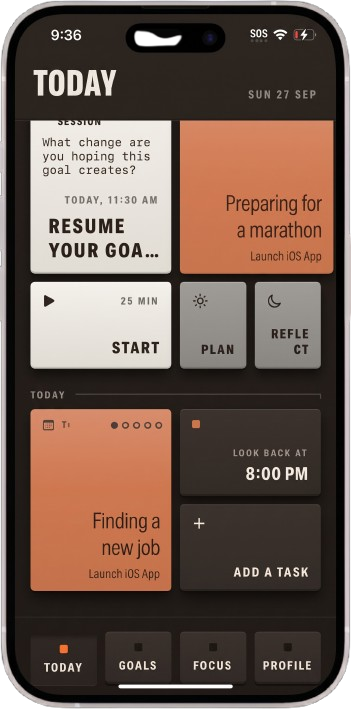
Name the handful of things worth your time — across your life, your work, your health — and turn them into a short list for today. A date on a task is a plan for when you'll do it, never a deadline hanging over you.
A coach in your pocket
Alakai helps you decide what actually matters, block the time to do it, focus without the noise, and reflect so the next week is sharper than the last. You stay in charge — Alakai keeps you moving.
Free early access, rolling out in waves. No noise. No spam.
The problem
You're not short on drive, and you're not short on time. What's missing is a system — a way to turn everything you care about into what you actually do this week.
So the important things get crowded out by the urgent ones, and the week disappears. That's the part Alakai fixes.
How it works
Progress isn't one heroic all-nighter. It's a loop small enough to keep — and Alakai runs it with you.
Name the handful of things worth your time — across your life, your work, your health — and turn them into a short list for today. A date on a task is a plan for when you'll do it, never a deadline hanging over you.
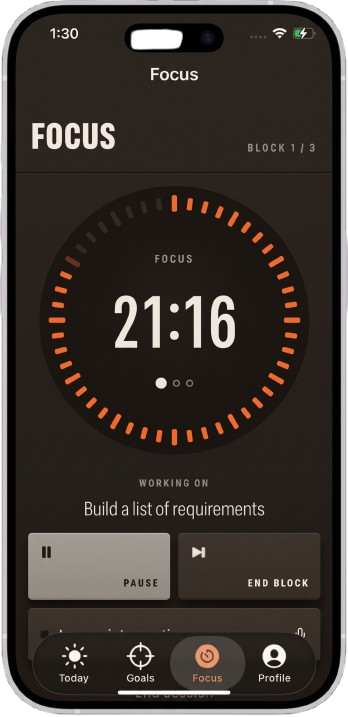
Pick a task and start a focus session. Work in blocks, take real breaks, and let the timer hold the line while the rest of the world waits its turn.
End with a two-minute check-in: what moved, what stalled, what's next. It's the step almost everyone skips — and the one that quietly changes everything.
Small loops, kept consistently, are how big things actually get done. Tomorrow starts a step ahead of today.
A look inside
What you get
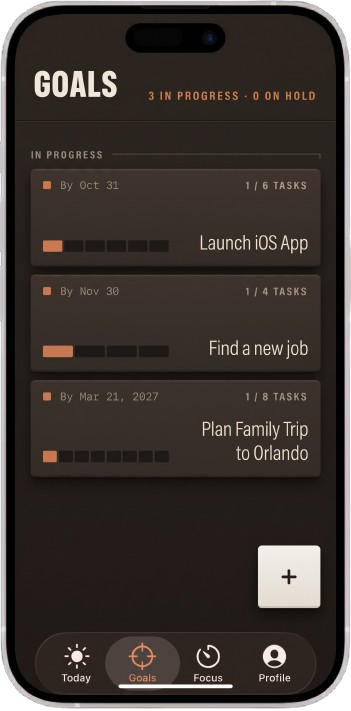
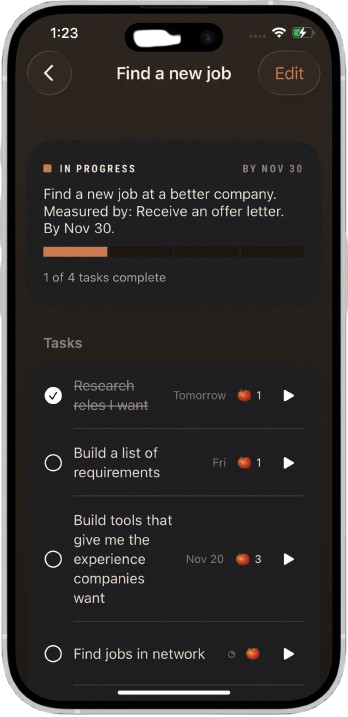
Personal, work, health — all the things you keep meaning to get to, finally in one place instead of five. Alakai keeps them organized and in front of you, so nothing that matters quietly slips.
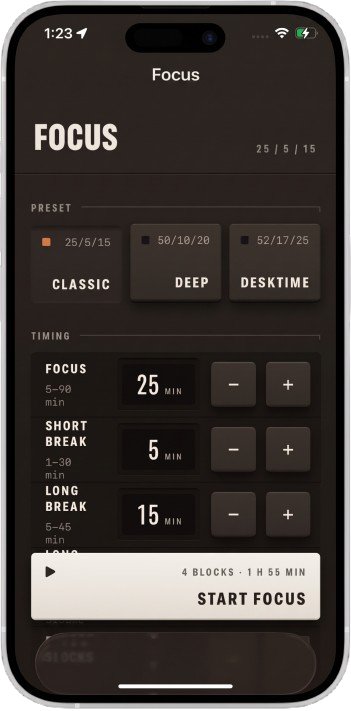
Choose one thing and start the clock. Focused blocks with built-in breaks — the proven pomodoro method — turn "I really should" into done, without burning out by noon.
Alakai never tells you what to do or does it for you. It asks the questions that make the answer obvious — the ones that turn a foggy week into a clear one. You stay in the driver's seat, always.
Yours, not automated
Alakai learns how you actually operate and adapts — more push when you want it, more room when you need it. It keeps things organized and asks the right questions, but it never makes the call for you. The decisions stay exactly where they belong.
The quiet habit of high performers
Coaching isn't a crutch, and it isn't a luxury. It's the not-so-secret habit behind a lot of the people who reach the top of what they do.
"Everyone needs a coach."
"Want to get great at something? Get a coach."
"Without him, I would not have the chance to be who I am."
The people at the very top of business, sport, and science almost all have someone in their corner — asking the sharp questions, keeping them honest, helping them prepare. That kind of coaching used to be out of reach for everyone else.
Alakai puts it in your pocket.
These are public statements about the value of coaching in general — not endorsements of Alakai.
The difference
| The moment | On your own | With Alakai |
|---|---|---|
| Deciding what to do | Everything swirling in your head | A short list of what matters |
| Getting started | Scroll, stall, and put it off | Start the timer and begin |
| Staying with it | Ten tabs, no traction | One thing, one focused block |
| Knowing it worked | Another week in a blur | A quick reflect, then adjust |
The method
Alakai isn't hustle-culture slogans. Every part of the loop is grounded in decades of research — on planning, focus, reflection, and why being asked a good question beats being told what to do. The findings are unusually consistent, and every one links to the original paper.
A meta-analysis found coaching delivers significant positive effects on all outcomes,
with the largest on the goal-directed self-regulation that keeps you on track.
Theeboom, Beersma & van Vianen, The Journal of Positive Psychology (2014). Read the study ↗
Across 94 tests and more than 8,000 people, deciding in advance when and where you'll act — a simple "if-then" plan — had a positive effect of medium-to-large magnitude (d = .65) on goal attainment.
Gollwitzer & Sheeran, Advances in Experimental Social Psychology (2006). Read the study ↗
In a sustained-attention experiment, brief mental breaks preempt vigilance decrements
— people who worked in blocks stayed sharp, while those who pushed straight through faded. It's the logic behind the pomodoro method: focus, breathe, go again.
Ariga & Lleras, Cognition (2011). Read the study ↗
Across 138 studies and nearly 20,000 people, monitoring goal progress is an effective self-regulation strategy
that reliably raises goal attainment — and works best when progress is recorded.
Harkin et al., Psychological Bulletin (2016). Read the study ↗
People who spent 15 minutes reflecting on what they'd learned performed 23% better than those who didn't. Thinking through what worked — not just doing more — is what moves you along the curve.
Di Stefano, Gino, Pisano & Staats, Harvard Business School (2014). Read the study ↗
The generation effect
is one of the most reliable findings in memory research: what you work out for yourself sticks far better than the same thing handed to you. A coach that asks — instead of tells — puts your own mind to work, so the insight is yours to keep.
Slamecka & Graf, Journal of Experimental Psychology (1978). Read the study ↗
Every finding links to the original paper so you can verify it. Quoted phrases are exact.
Privacy
Your goals, your plans, your off-days — private, protected, and never sold. Alakai exists to help you, not to turn you into a product you didn't ask for.
Early access
Your goals, your list, and your focus — finally in one place.
Free early access, rolling out in waves. Private by design.